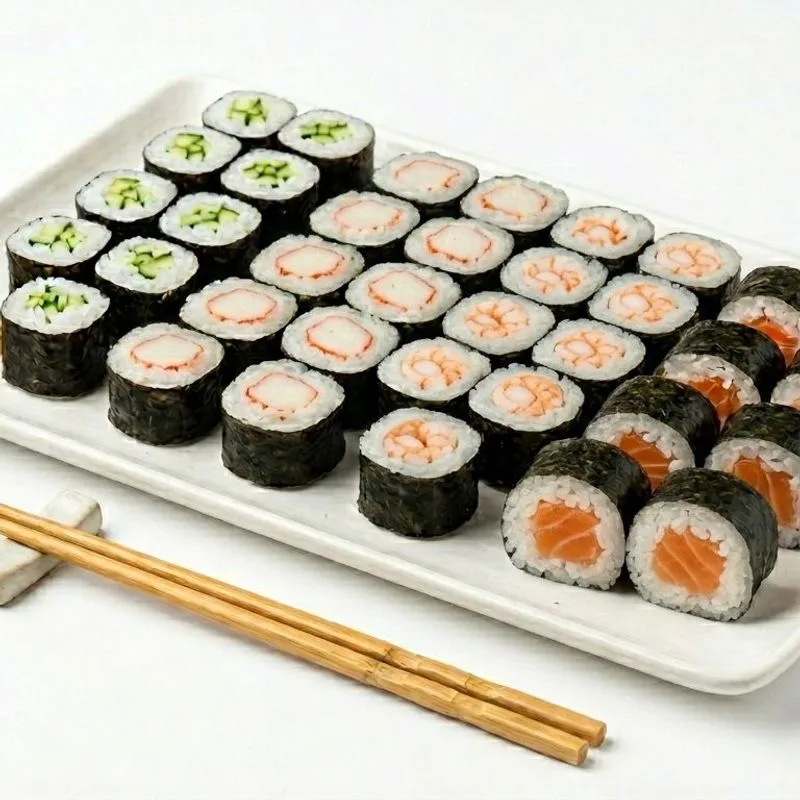
Maki Set
巻物 · makimono
- Salmon Maki
- Shrimp Maki
- Kappa Maki
- Crab Maki
In Japanese, the verb maku 巻く means to wrap, and it is the common ancestor of two beautiful words. One is makimono 巻物: the hand scrolls on which stories and paintings were set down for centuries, read as they unrolled from right to left. The other is makizushi 巻き寿司: sushi rolled in a bamboo mat. In Japanese culture, wrapping is not for hiding; it is for showing in sequence. The scroll and the roll do the same work: they tell the story not all at once, but as they open.
When the knife slices the roll, the scroll opens: nori’s black frame, the white page of rice, and at the center, the story’s protagonist.
Masters know the humble-looking difficulty of maki. Crowded rolls forgive mistakes; a slender maki of two or three ingredients forgives none. The firmness of the rice is measured in millimeters: loose enough to fall apart against the teeth, firm enough not to fall apart in the hand. The nori must stay crisp, the filling must sit dead center, the slices must match.
This set of thirty-two slices is the anthology of that plain craft. Each slice is a small scroll, opened; do not hurry the reading.