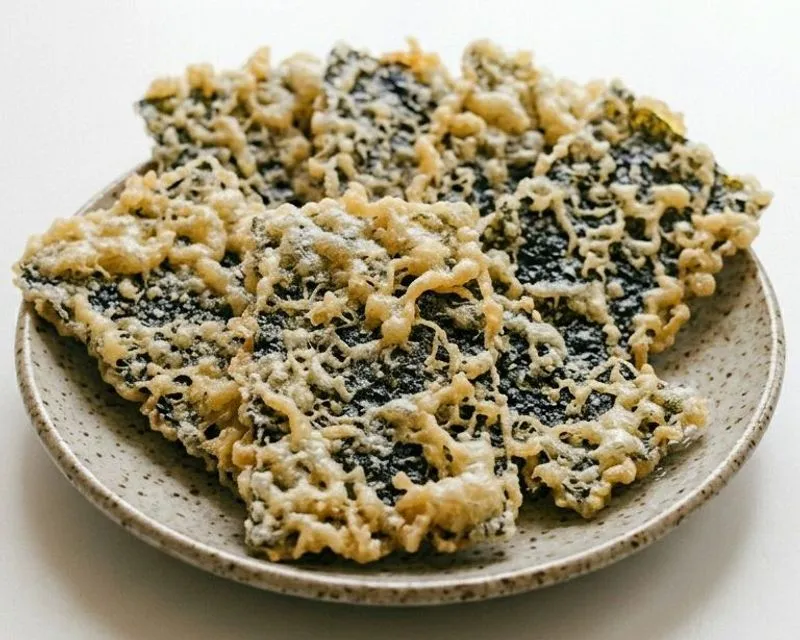
Crispy Nori
海苔 · nori
In the city of Uto in Kumamoto, southern Japan, there stands a monument, and every year on the 14th of April a ceremony is held before it. The person honored is not Japanese; she is a seaweed scientist from Manchester who never in her life saw Japan: Kathleen Drew-Baker. The nori growers call her Umi no Haha, Mother of the Sea.
Here is why. For centuries, nori farming was a matter of luck; no one knew where the seaweed was born or how it multiplied out in the water. One year the harvest overflowed, the next it failed entirely. In postwar Japan, production was near collapse. Then in 1949 Drew-Baker published a short paper in Nature: the red alga she was studying on the Welsh coast had a microscopic phase, long mistaken for a separate species, and that phase spent the winter inside oyster shells. The seaweed’s lost season had been found. Japanese scientists turned her discovery into a method of seeding, and nori farming went from gambling to craft.
The thin, crackling leaf on your plate is the joint work of the sea, of science, and of two distant islands. The ceremony at Uto is renewed every April, because Japan is a cuisine that does not forget a kindness.